CCLConscious City
Laboratory

Architecture × Cybernetics × Artificial Intelligence

How can cities become conscious?

A research field guide to artificial intelligence, urban systems and human participation—based on Dietmar Köring’s 2019 dissertation at TU Berlin.

Work 01 · Dissertation · 2019Technische Universität BerlinDOI 10.14279/depositonce-8466 ↗

00 / Thesis

The city is not a machine to be optimised from outside. It is a living field of feedback in which citizens, planners, institutions and algorithms continuously change one another.

Die Stadt ist keine Maschine, die von außen optimiert wird. Sie ist ein lebendiges Feld der Rückkopplung, in dem Menschen, Planung, Institutionen und Algorithmen einander fortlaufend verändern.

01—09 / Research Questions

Nine entry points into the research

Each section answers a concrete question and traces it back to the dissertation’s concepts, case studies and prototype.

01

How will AI change architecture?

AI changes architecture when data becomes part of the spatial decision-making process—not merely a tool used after design.

From tool to urban condition

Artificial intelligence, sensors, robotics, digital fabrication and the Internet of Things create a new condition for architecture. They affect what can be observed, who can participate and how decisions are made. Architecture becomes an interface through which knowledge is produced and negotiated.

The architect as integrator

The thesis anticipates a shift from the isolated author toward an integrator of heterogeneous systems. Every model simplifies reality, every optimisation contains a goal and every interface decides which feedback can enter the process. Design judgment therefore remains essential.

Kurzfassung: Architektur muss Echtzeitdaten integrieren, ohne die Verantwortung für die in Entscheidungen eingeschriebenen Werte abzugeben.

Source context: Introduction; Ethics, AI, and Human Beings; Part IV.

02

What is a Conscious City?

A Conscious City is not a city that thinks by itself. It helps people perceive, discuss and act upon the systems shaping urban life.

Beyond the Smart City

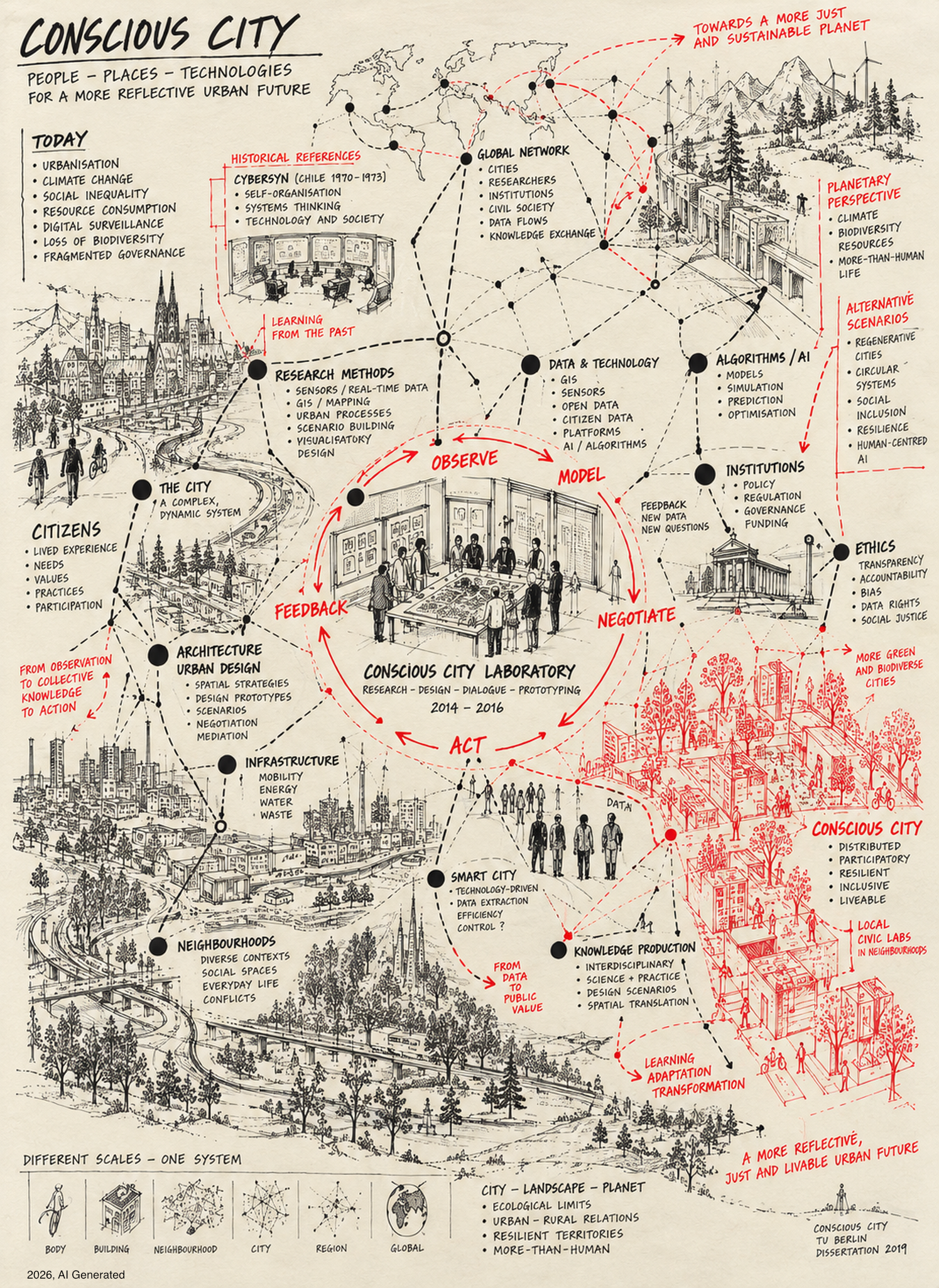
While a Smart City is frequently described through connected infrastructure and efficient services, the Conscious City shifts attention to awareness. It asks what citizens know about the systems acting around them and whether they can influence those systems.

The city as a device

A city can be understood as a device for reducing complexity. It does not erase complexity; it gives relationships a form in which they can be observed and acted upon. A physical laboratory makes otherwise invisible networks publicly discussable.

Kurzfassung: Eine Conscious City macht die Systeme des urbanen Lebens wahrnehmbar und ermöglicht Bürgerinnen und Bürgern, Entscheidungen auszuhandeln.

Source context: The City, Interaction, and Human Beings; Part IV.

03

What is second-order cybernetics?

Second-order cybernetics begins when the observer recognises that they are part of the system they are trying to understand and change.

Feedback as design material

An action produces an effect; that effect returns as information; the next action changes in response. In architecture this circularity can connect design decisions to occupancy, climate, movement, perception and public response.

The observer inside the system

No map, model or dataset is simply neutral. The architect, citizen, client and algorithm each frame the problem differently. A productive process makes those frames available for comparison and allows understanding to emerge through communication.

Kurzfassung: Kybernetik zweiter Ordnung erkennt, dass Planende Teil des Systems sind, das sie beobachten.

Source context: Chapter 1.2 BrainBox and Cybernetics; Methodology.

04

What does participation mean in the age of AI?

Participation is meaningful when people can understand the frame of a decision, contribute knowledge and see how feedback changes the next iteration.

Participation is not data collection

Digital participation can become a one-way process in which a platform gathers responses and returns an opaque result. The dissertation proposes a circular alternative: participants encounter scenarios, discuss conflicts, observe consequences and provide feedback that reshapes the model.

Agency in automated environments

As AI mediates mobility, energy, housing and public services, citizens need ways to question inputs, goals and outcomes—not only choose between pre-defined options.

Kurzfassung: Menschen müssen den Entscheidungsrahmen verstehen, eigenes Wissen einbringen und erkennen können, wie ihr Feedback den nächsten Schritt verändert.

Source context: Introduction; Part III — The BrainBox.

05

What can architecture learn from Cybersyn?

Cybersyn shows that a data system is never only technical: its interfaces, rooms and communication rules shape who can understand and govern it.

A system with a spatial interface

Project Cybersyn was developed in Chile during Salvador Allende’s government with the involvement of Stafford Beer. Its operations room translated data into a shared decision environment and demonstrated that interface design is part of institutional design.

The political lesson

The same technical capacity can support participation or control depending on ownership, access and purpose. Who defines the indicators, who sits in the room and who can challenge the model are architectural as well as governance questions.

Kurzfassung: Project Cybersyn zeigt Potenzial und politische Risiken rechnergestützter Koordination.

Source context: Chapter 1.3 The Grassland Biome and Cybersyn.

06

Why are planning problems wicked?

A wicked problem cannot be separated from the act of defining it: every proposed solution changes the situation and reveals a different problem.

Tame, complex and wicked

A tame problem has known criteria. A complex problem can be modelled within a defined frame. A wicked problem resists closure because stakeholders disagree about both the problem and the desired outcome. Housing, mobility and climate adaptation combine facts with values.

Why optimisation is insufficient

An algorithm can optimise only what has been expressed as a goal. Choosing those goals and variables is already a political act. Models should therefore support comparison, expose assumptions and help participants learn rather than claim to deliver a final answer.

Kurzfassung: Stadtplanung braucht lernende, nachvollziehbare Prozesse statt endgültiger Antworten.

Source context: Chapter 1.7 Tame, Complex, and Wicked Problems.

07

What are cyber-physical systems?

Cyber-physical systems connect computation, sensors, networks and physical processes in continuous feedback loops.

When cyberspace meets physical space

Sensors observe a condition, computation interprets it, a network communicates it and an action changes the physical environment. The changed environment is sensed again. The defining feature is the coordinated loop, not any single smart object.

A civic infrastructure

Connected environments can quietly govern everyday life. Citizens therefore need awareness of pervasive networks and a way to respond. Otherwise responsiveness becomes one-sided observation.

Kurzfassung: Für Architektur entscheidend ist das Zusammenwirken von Sensoren, Netzwerken, Berechnung und physischen Prozessen.

Source context: Chapter 2.4 Cyber-Physical Systems.

08

How does the BrainBox work?

The BrainBox is a physical interface for combining participants, planning parameters and scenarios in an iterative urban decision process.

A room for protoplanning

People gather around an interactive table, compare planning elements, discuss scenarios and observe how relationships change. Proposals remain provisional long enough to be tested and revised before becoming a fixed masterplan or policy.

Iterated through use

Versions of the prototype were tested through experiments, surveys and public feedback from 2014 to 2016. The prototype follows the cybernetic logic it represents: each encounter returns information that changes the next version.

Kurzfassung: Die BrainBox verbindet Beteiligte, Planungsparameter und Szenarien in einem räumlichen Interface.

Source context: Part III — The BrainBox.

09

What is the future role of architects?

The architect’s future value lies less in producing isolated objects and more in framing, connecting and negotiating complex systems.

Generalist and integrator

Complex urban systems exceed any single discipline. The architect can recognise relationships across different fields and connect design, technology, policy, citizens and ecological knowledge. This requires technical literacy, spatial imagination and the ability to structure communication.

Teaching a new consciousness

Architecture must develop awareness of visible and invisible networks, recognise the ethical goals embedded in tools and communicate uncertainty without surrendering the need to act.

Kurzfassung: Architektinnen und Architekten verbinden Gestaltung, Technologie, Politik, Gesellschaft und ökologisches Wissen und verantworten die Ziele digitaler Prozesse.

Source context: Introduction; Chapter 4.4 Significance of the CCL.

Method / Recursive by design

Observe. Model. Negotiate. Act. Repeat.

01

Observe from within

The observer is part of the system. Every map, dataset and model has a position.

02

Make relations visible

Represent data without mistaking the representation for reality.

03

Negotiate scenarios

Use prototypes to expose conflicts, goals and dependencies.

04

Return the feedback

Let consequences change the next action. Learning closes the loop.