CCLConscious City
Laboratory

Posthumanism × Avatars × AI × Digital Culture

Where does the human end?

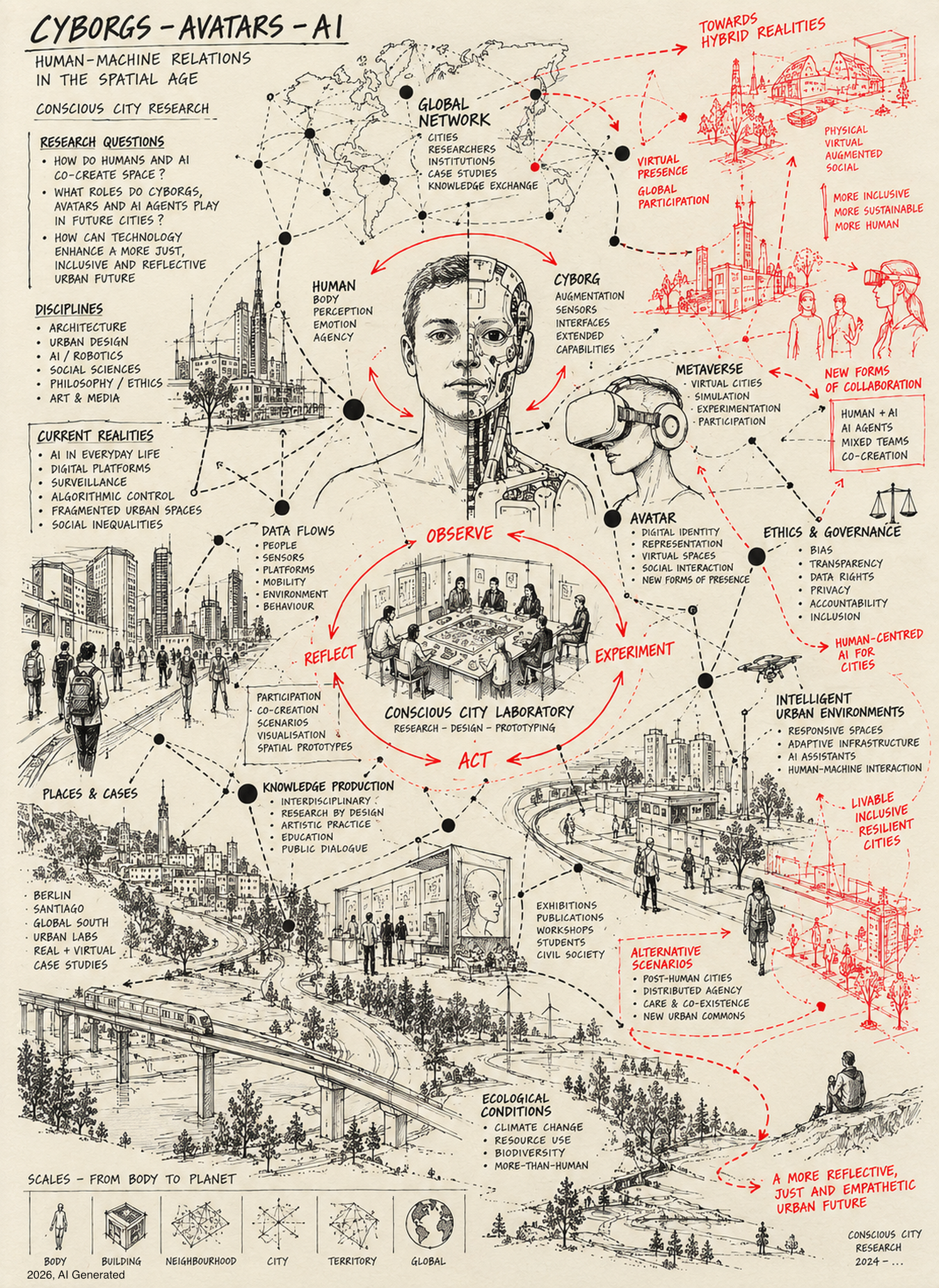
A dialogical field guide to cyborgs, digital selves, artificial intelligence, data, art and embodied identity—based on the 2023 podcast Probing the Digital: Cyborgs, Avatars and AI.

Podcast transcription · 2023Recorded 15.09.2023 · RigaModerator: Dietmar KöringCo-moderators: Sebastian Muehl · Eva Sommeregger

04 / Dialogue

The digital cannot be understood apart from the physical. Cyborgs, avatars and AI do not simply announce a posthuman future—they force us to renegotiate identity, embodiment, power and participation in the present.

Digitales und Physisches lassen sich nicht mehr getrennt betrachten. Cyborgs, Avatare und KI verweisen nicht nur auf eine mögliche posthumane Zukunft, sondern verändern bereits heute Identität, Körperlichkeit, Macht und Teilhabe.

01—09 / Dialogue Questions

Nine probes into the digital human

The podcast stages disagreement rather than one final doctrine. Its value lies in the tensions between transhumanist, sociological, artistic and architectural perspectives on technological change.

01

How do cyborgs, avatars and AI reshape human existence?

The podcast begins from the premise that emerging technologies require a reconsideration of the perceptual, ethical and aesthetic relations between human subjects, technologies and digital media.

Not one technology, but a hybrid condition

Cyborgs, avatars and AI are approached as different ways of testing the border between human beings and technical systems. Their importance is not confined to a distant future: social media, generative systems, screens, digital identities and networked platforms already produce hybrid environments in which people act and perceive themselves.

An interdisciplinary question

The dialogue deliberately brings philosophy, media theory, art, architecture and jewellery into the same conversation. This produces no single definition of the posthuman. Instead, it makes visible how differently technological change is interpreted depending on whether the focus is ontology, politics, artistic practice, embodiment or design.

Kurzfassung: Der Podcast versteht Cyborgs, Avatare und KI als unterschiedliche Zugänge zu einer bereits heute hybriden Mensch-Technik-Beziehung.

Source context: Opening and abstract; 00:00:00–00:02:15.

02

Will posthuman technologies deepen inequality?

Technological inequality is not only a question of who gains access first; it is also a question of who bears uncertainty, risk and political responsibility.

Enhancement creates distribution questions

The discussion identifies gene technologies, brain–computer interfaces, AI and digitalisation as technologies capable of altering human life. Sorgner treats equal access as a central political issue once a technology has proven beneficial, warning against a future in which technological enhancement reinforces social hierarchies.

First access is not automatically privilege

The dialogue complicates a simple rich-versus-poor model by noting that early access can include unknown risks. The ethical task is therefore both distributive and temporal: societies must evaluate benefits and dangers and then decide politically how proven benefits should be made broadly available.

Kurzfassung: Technologische Gerechtigkeit betrifft Zugang, Risiko und die politische Entscheidung, wie erwiesene Vorteile verteilt werden.

Source context: Posthuman technologies and inequality; 00:02:15–00:05:51.

03

Are humans already cyborgs?

The podcast keeps this question deliberately unresolved: one position understands humans as fundamentally techno-natural creatures, while another insists that collapsing every distinction weakens our capacity to understand identity.

The techno-natural human

Sorgner presents the cyborg as a non-dualistic figure. Technology is not categorically separate from human nature; language itself can be understood as a technology, and humans have always developed, incorporated and discarded technologies as part of their lives.

The value of distinctions

Ries resists the claim that everyone is simply becoming a cyborg. For him, social thought depends on making meaningful differences. Cyborgs and avatars can name genuinely new technological forms without erasing the category of the human or turning every form of existence into the same thing.

Kurzfassung: Der Cyborg ist entweder Ausdruck unserer immer schon technischen Natur oder eine neue Kategorie, die gerade durch ihre Differenz zum Menschen interessant wird.

Source context: Cyborg ontology and politics; 00:05:51–00:10:24.

04

What is a digital self?

A digital self is neither simply fictional nor identical to the physical person. It can extend, mediate, protect and selectively curate identity.

The avatar as proxy and alter ego

Popolitova describes Serafita as a digital self and an avatar that extends her artistic practice. The figure enhances the narrative and performative capacities of jewellery and acts as a proxy or alter ego. An attack on the avatar can therefore also be experienced as an attack on the person behind it.

Distance is part of identity

At the same time, the avatar is intentionally given another name. That distance can offer protection when political issues are addressed. The avatar is thus both part of the artist and a curated part of the artist—a useful model for understanding identity as mediated rather than simply duplicated.

Kurzfassung: Ein Avatar kann zugleich Erweiterung, Stellvertreter, Schutzraum und bewusst kuratierter Teil einer Person sein.

Source context: Digital self, Serafita and mediated identity; 00:11:09–00:16:40.

05

Can consciousness be transferred to a machine?

The discussion strongly challenges mind-uploading narratives because personality is embodied and because no existing digital system demonstrates the chain of capacities that such a transfer would require.

Personality is more than information

Sorgner argues that a human personality would have to include bodily capacities and learned practices, not just memories or verbal descriptions. The example of playing tennis illustrates the problem: what a person is includes embodied know-how that cannot simply be separated from the body and copied to a hard drive.

From immortality back to real problems

The panellists treat digital immortality as an unhelpful utopian distraction. Extended health span may be a meaningful technological goal, but the conversation repeatedly redirects attention from spectacular future promises to present questions of power, society, privacy and the uses of AI.

Kurzfassung: Mind Uploading wird als spekulative Utopie kritisiert, weil Persönlichkeit verkörpert ist und heutige digitale Systeme die notwendigen Voraussetzungen nicht erfüllen.

Source context: Mind uploading, embodiment and immortality; 00:16:40–00:26:50.

06

What matters more than digital utopias?

The most urgent digital questions are not whether superintelligence or immortality will arrive, but who possesses power, who owns data and how technologies reshape existing social relations.

Utopian stories generate attention

The dialogue suggests that narratives of immortality, mind uploading and superintelligence receive disproportionate attention because they resonate with hopes, fears and media logics. Ries also interprets some of this fascination as compensation or escapism from difficult social realities.

Return to politics

Muehl and Sorgner explicitly redirect the discussion toward power relations, privacy and data ownership. Ries adds that digital transformation can itself obscure other urgent problems such as climate change and social injustice. AI should therefore be analysed within society, not treated as a technological answer to society as a whole.

Kurzfassung: Statt Zukunftsmythen stehen Machtverhältnisse, Datenschutz, Datenbesitz und bestehende gesellschaftliche Probleme im Mittelpunkt.

Source context: Utopianism, escapism and power; 00:19:48–00:30:32.

07

Who owns the digital self and its data?

Digital identity is inseparable from infrastructures that collect, classify, monetise and redistribute the data through which that identity becomes visible.

No AI without data

The conversation frames data as a political resource. It asks where data come from, who can collect them, how regulation influences innovation and what happens when data-intensive development is concentrated in a small number of states or corporations.

Platforms capitalise creative identity

Popolitova’s augmented-reality jewellery offers a concrete artistic example: creative work uploaded as social-media filters becomes embedded in a platform economy. The artist may retain a sense of authorship and identity, while the platform can capitalise the content and users lose control over later reuse.

Kurzfassung: Die digitale Identität entsteht innerhalb von Daten- und Plattforminfrastrukturen, die Sichtbarkeit ermöglichen, aber zugleich Besitz, Nutzung und Verwertung verschieben.

Source context: Data, platforms and digital art; 00:30:32–00:38:07.

08

Do NFTs solve digital authorship?

NFTs can verify a specific relationship between a digital object, creator and owner, but the dialogue refuses to equate technical authentication with artistic value or freedom from platform power.

Authentication and a posthuman aura

Sorgner argues that blockchain can establish uniqueness and traceable authorship for digital work, giving artists and collectors a way to distinguish an authenticated instance even when images or files can otherwise be copied.

Empowerment and commodification

Popolitova and Muehl stress the ambiguities. NFT markets can open routes for artists outside traditional galleries, yet they can also intensify commodification and leave institutions struggling with wallets, currencies and preservation. Platform owners still retain significant visibility, surveillance and financial power.

Kurzfassung: Blockchain kann Authentizität nachweisen, löst aber weder die Frage nach künstlerischer Qualität noch nach Plattformmacht, Reproduzierbarkeit und Institutionen.

Source context: NFTs, blockchain, authorship and digital architecture; 00:38:07–00:50:27.

09

What could a posthuman future look like?

The closing round offers no shared posthuman destination. Instead it presents several trajectories: renewed humanism, technological co-evolution, multiple identity and an increasingly inseparable relation between digital and physical life.

Support humans—or transform the category?

Ries rejects the idea of posthumanism and wants AI to support humans in solving real problems. Sorgner stresses the plurality of post-, trans- and metahuman positions and points to technologies that are already changing reproduction and the body. Popolitova imagines bodies and technologies evolving simultaneously.

Multiplicity rather than replacement

Muehl argues that analogue and digital art will continue in parallel and often intersect. Sommeregger goes further, proposing posthuman existence as a challenge to the unified subject: avatars can blur body and environment and open identity toward multiplicity. The future is therefore presented less as the replacement of humans than as a contested reorganisation of relations.

Kurzfassung: Die Zukunft reicht im Gespräch von einem erneuerten Humanismus bis zu multiplen Identitäten und einer untrennbaren Verschränkung von digitalem und physischem Leben.

Source context: Closing trajectories; 00:50:27–01:01:37.

Dialogical loop / Probing the Digital

Distinguish. Embody. Question. Trace power. Coexist.

01

Distinguish positions

Do not collapse human, cyborg, avatar and AI into one category before asking what their differences make possible.

02

Keep the body present

Identity, perception and knowledge remain embodied even when mediated through screens, platforms and digital proxies.

03

Question the utopia

Test spectacular future claims against what technologies can actually do and which present problems the claims may obscure.

04

Trace power and data

Ask who owns infrastructures, collects data, defines access and captures value from digital identities and creative work.

05

Design coexistence

Treat digital and physical realities as interdependent fields in which identities, bodies, art and technologies continue to evolve together.