CCLConscious City
Laboratory

Cybersyn × Industry 4.0 × Human Participation

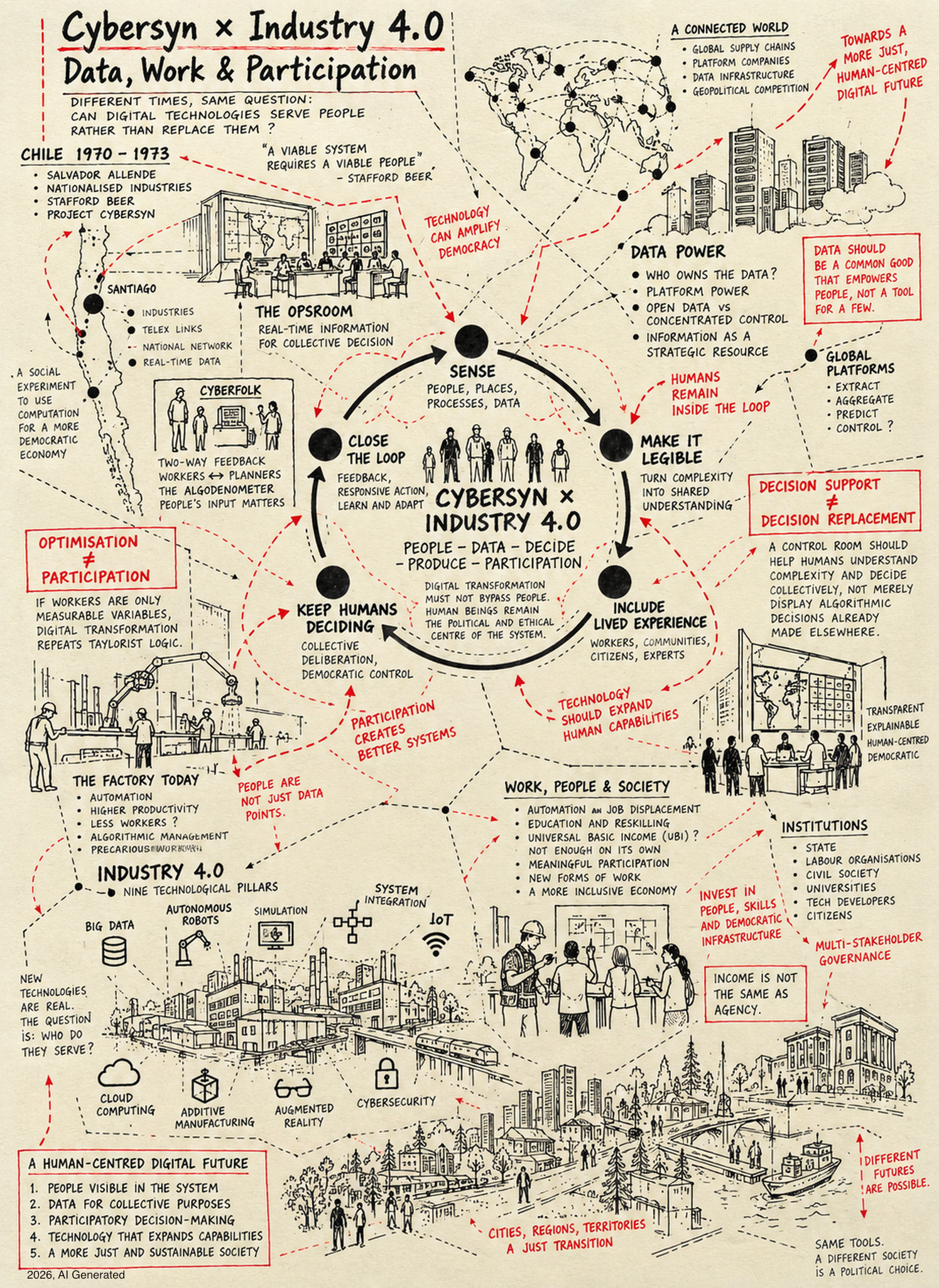
What should we have learned from Cybersyn?

An epistemological field guide to Cybersyn, Industry 4.0, data, work and democratic participation—based on Dietmar Köring’s 2021 chapter on the socialist cybernetic experiment in Chile.

Work 03 · Book Chapter · 2021IGI Global · Chapter 5DOI 10.4018/978-1-7998-4285-9.ch005 ↗

00 / Thesis

Digital transformation should not bypass people. The lesson of Cybersyn is that data and computation can support complex decisions while human beings remain the political and ethical centre of the system.

Digitale Transformation darf den Menschen nicht umgehen. Cybersyn zeigt, dass Daten und Berechnung komplexe Entscheidungen unterstützen können, während Menschen das politische und ethische Zentrum des Systems bleiben.

01—09 / Research Questions

Nine lessons from Cybersyn for Industry 4.0

The chapter reads the Chilean Cybersyn project against contemporary automation, AI and Industry 4.0 to ask who controls data, who makes decisions and how human participation can remain meaningful.

01

Why revisit Cybersyn now?

Cybersyn matters because it anticipated real-time, data-driven production decades before Industry 4.0, while embedding those technologies in a radically different social and political project.

A prototype before the infrastructure existed

Developed in Chile between 1970 and 1973, Cybersyn connected nationalised industries through telex communication, computational modelling and an operations room. The chapter describes it as an early digital decision-support system and a kind of proto-internet whose theoretical ambition exceeded the technological resources then available.

The comparison is ideological as well as technical

The paper explicitly contrasts a socialist attempt to raise production without unemployment with the contemporary logic of Industry 4.0. Both seek coordination and productivity, but they differ in who is meant to benefit and what role people retain inside the system.

Kurzfassung: Cybersyn ist relevant, weil es viele Prinzipien heutiger vernetzter Produktion vorwegnahm, sie aber mit gesellschaftlicher Teilhabe und Beschäftigung verband.

Source context: Abstract; Introduction; Cybersyn; Conclusion.

02

How should humans relate to intelligent systems?

Humans inevitably adapt to technologically modified environments, but the chapter argues that awareness and knowledge are necessary if adaptation is not to become passive submission.

Adaptation is a feedback loop

Drawing on Wiener, Tegmark and Fischer, the paper frames humans and environments as mutually modifying. Digital transformation therefore changes not only tools and workplaces but also the knowledge and consciousness required to act within them.

Who steers the new environment?

The crucial question is whether people remain able to understand and influence responsive environments, or whether algorithms increasingly become the effective decision-makers. Fair participation with advanced AI is therefore presented as an ethical problem rather than merely a technical one.

Kurzfassung: Menschen müssen sich an digitale Umgebungen anpassen können, ohne ihre Fähigkeit zu verlieren, diese Umgebungen selbst mitzugestalten und zu steuern.

Source context: Introduction — human-machine relations, adaptation and digital transformation.

03

What made Cybersyn different?

Cybersyn automated information flows without attempting to automate away the human act of political and organisational decision-making.

The Opsroom as a decision interface

Production data could be transmitted, processed and simulated, but the operation room was designed for people to interpret that information together. The seven seats deliberately reflected limits of human short-term memory and turned computational complexity into a collective decision environment.

Decision support, not decision replacement

The distinction is central to the chapter’s criticism of Industry 4.0. Contemporary systems may be more efficient when algorithms make decisions directly, but efficiency becomes ethically problematic when the people affected by decisions no longer appear in the decision process.

Kurzfassung: Cybersyn nutzte Computer zur Unterstützung menschlicher Entscheidungen – nicht, um Menschen aus der Entscheidung zu entfernen.

Source context: Introduction; description of the Opsroom and human decision-making.

04

Can real-time systems be democratic?

Cyberfolk suggests that responsiveness can work in two directions: systems can sense production, but they can also receive direct qualitative feedback from citizens and workers.

The algedonometer

The proposed Cyberfolk component explored devices through which participants could express positive or negative responses in real time. The aggregated feedback was visible to both participants and the speaker, making the feedback loop itself observable.

Participation as system architecture

The chapter reads this unfinished experiment as evidence of an advanced democratic governance idea. Rather than treating people as sources of extractable data, it imagined their subjective experience as an active input into governance.

Kurzfassung: Cyberfolk machte menschliches Empfinden und Rückmeldung zu einem Bestandteil des Systems – nicht nur Produktionsdaten.

Source context: Cybersyn — Cyberfolk, algedonometer and democratic governance.

05

Who is Industry 4.0 for?

The chapter questions the language of a “fourth industrial revolution” when its transformation is driven largely by major corporate actors rather than by the people whose work and lives are reorganised.

Nine technological pillars, one missing centre

Big data, autonomous robots, simulation, system integration, IoT, cloud computing, additive manufacturing, augmented reality and cybersecurity create powerful connected production environments. Yet the paper argues that the human being should function as the architrave resting on these pillars.

Optimisation is not participation

Real-time connectivity enables tracing and optimisation on an unprecedented scale. But if workers enter the system only as measurable variables, digital transformation repeats the logic of Taylorism rather than creating a genuinely human-centred industrial environment.

Kurzfassung: Industry 4.0 braucht nicht nur technische Säulen, sondern den Menschen als tragendes Element des Systems.

Source context: Industry 4.0 — real-time optimisation, nine pillars and human participation.

06

Does UBI solve technological unemployment?

A universal basic income may address the loss of earnings, but the chapter argues that it cannot by itself solve the deeper problem of exclusion from meaningful social and economic participation.

Automation changes the structure of work

Robotics, AI and new production methods will eliminate some jobs while creating others. The paper therefore calls for early awareness, education and career choices oriented toward roles that remain necessary in a transformed economy.

Income is not the same as agency

The chapter warns that basic income could become little more than a compensatory industrial payment if people are offered no real opportunities. Cybersyn is instructive precisely because its political ambition connected production with employment and participation rather than treating unemployment as an external side effect.

Kurzfassung: Grundeinkommen kann Einkommensverluste abfedern, ersetzt aber keine gesellschaftliche Aufgabe, Mitbestimmung oder Perspektive.

Source context: Introduction and Conclusion — unemployment, UBI and future work.

07

Who owns and governs the data?

Cybersyn anticipated that information would become a strategic resource, making ownership and governance of data inseparable from the politics of digital systems.

Information as a resource

The chapter recalls Stafford Beer’s argument that information is a national resource. In today’s context this raises questions about open data, platform power and the means by which data are produced and collected.

Extraction is not neutral

Industry 4.0 and smart environments depend on continuous data gathering. The paper uses this dependence to ask whether digital infrastructures serve collective coordination or reinforce concentrated control by global actors.

Kurzfassung: Wer Daten besitzt, sammelt und auswertet, bestimmt wesentlich mit, wer digitale Systeme tatsächlich kontrolliert.

Source context: Cybersyn — information as a national resource; Industry 4.0 — data exploitation and ownership.

08

What should a control room control?

A control room should make complexity understandable enough for people to steer a system; it should not merely visualise decisions already made elsewhere by algorithms.

Control as understanding

Cybersyn’s operations room translated flows of data into a shared spatial interface. Its significance was not the spectacle of control but the possibility of collective interpretation, discussion and action under conditions of complexity.

Control as a political question

The historic disagreement between Beer and Allende over the meaning of control remains relevant. Is control concentrated at the top, distributed to participants, or delegated to computation? The answer determines whether digital coordination becomes emancipatory or exclusionary.

Kurzfassung: Ein Control Room sollte Menschen befähigen, Komplexität gemeinsam zu verstehen und Entscheidungen zu treffen – nicht nur algorithmische Ergebnisse anzeigen.

Source context: Cybersyn — Opsroom, Beer, Allende and the question of control.

09

What is the lasting lesson?

The enduring lesson is not to reproduce Cybersyn technically, but to recover its insistence that human participation must remain inside the feedback loop of digital transformation.

Human-centred responsive environments

The chapter concludes that interactive and responsive environments are necessary for understanding the complexity of AI-driven production and its effects on society. But those environments need to be steered by people and evaluated according to how they enable human participation.

An ethical framework for transformation

Because digital systems affect everyday life, work and political power, the paper calls for a broader ethical debate and ultimately for a universal code of ethics. The point is not to reject AI or automation, but to ensure that human beings remain the focus rather than becoming accessories to technological possibility.

Kurzfassung: Die wichtigste Lehre aus Cybersyn lautet: Digitalisierung muss als gesellschaftlicher Rückkopplungsprozess gestaltet werden, in dem Menschen sichtbar, beteiligt und entscheidungsfähig bleiben.

Source context: Conclusion.

Human-centred loop / Lessons from Cybersyn

Sense. Understand. Participate. Decide. Return.

01

Sense the system

Collect real-time information about production and environments without confusing measurement with the whole reality.

02

Make it legible

Translate complexity into interfaces that people can understand, discuss and contest.

03

Include lived experience

Return qualitative feedback from citizens and workers to the system instead of treating people only as data sources.

04

Keep humans deciding

Use computation as decision support while preserving responsibility, participation and political agency.

05

Close the loop

Let the consequences of decisions flow back into the next cycle of learning and collective action.